


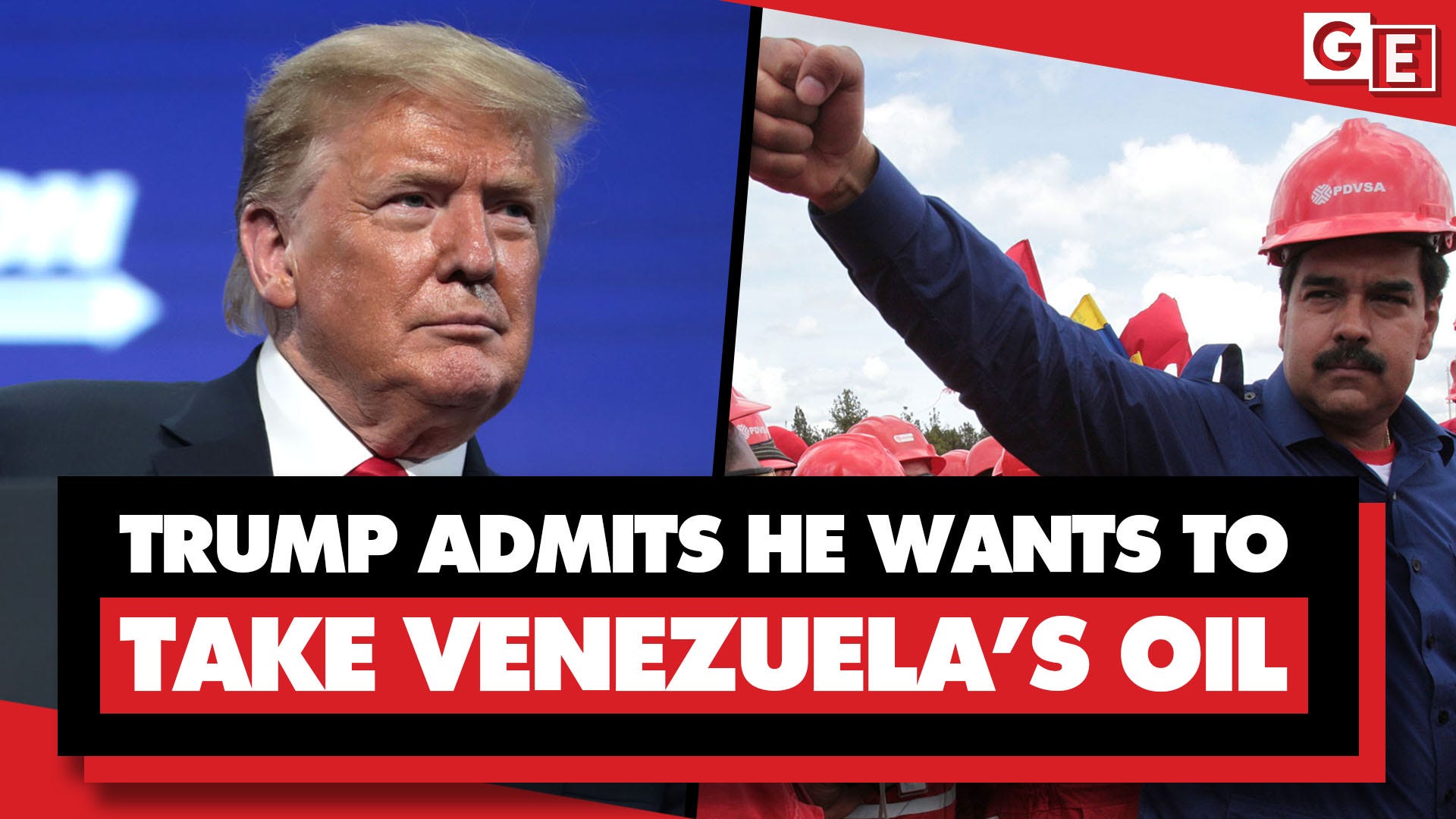
Donald Trump has openly admitted that he wants to take Venezuela’s oil. Top US officials have made it clear that this is a key reason for their war on the South American nation.
Trump declared an illegal naval blockade of Venezuela on December 16. The US government aims to prevent Venezuela from selling oil to China, to starve Caracas of export revenue.
The Trump administration is also illegally blocking Venezuela from importing crucial goods — including the light crude and chemicals needed to process and refine its own heavy crude.
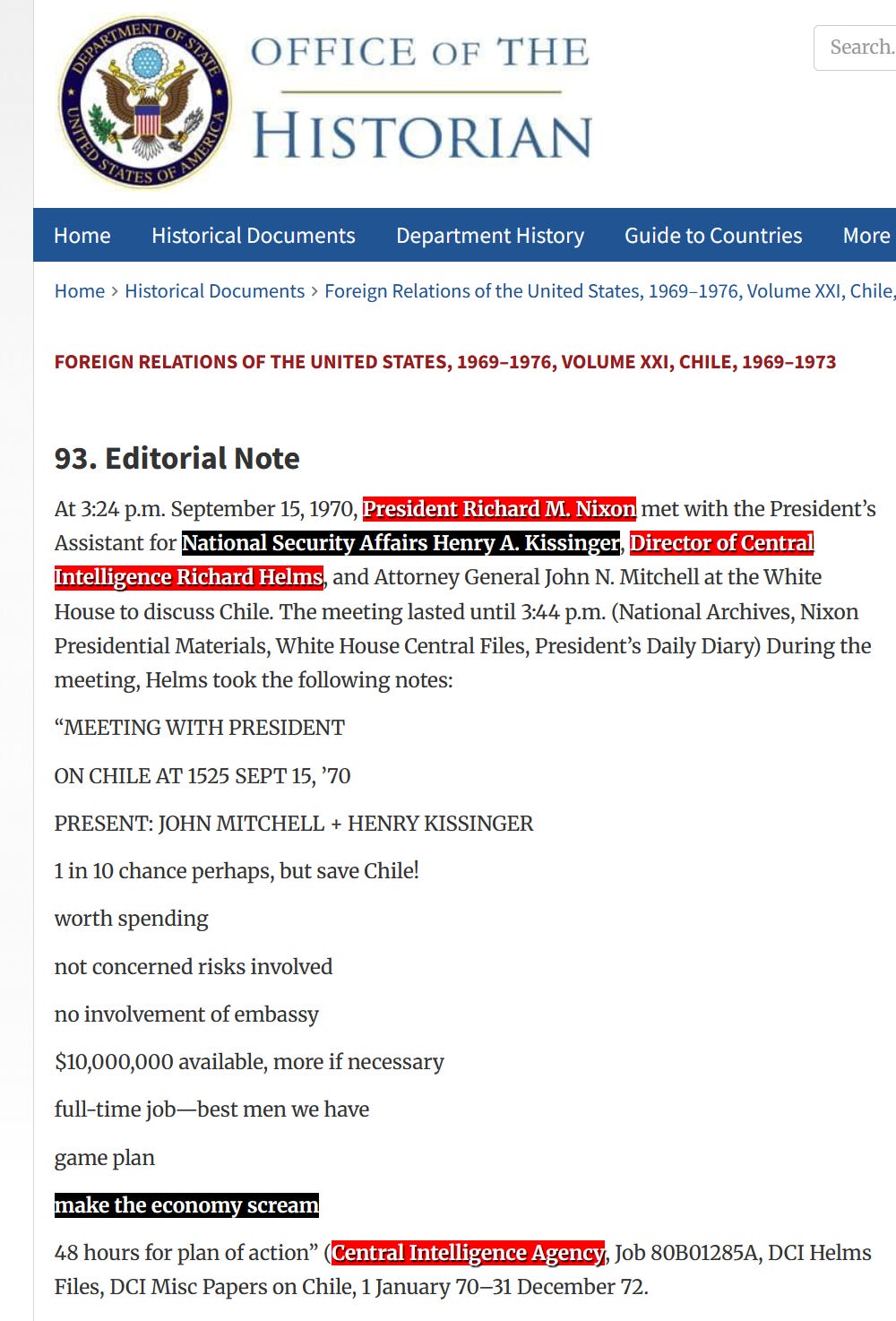
The US goal is to bring about an extreme crisis in Venezuela — to “make the economy scream” — hoping it leads to regime change.
Trump says US corporations should control Venezuela’s oil
On December 17, a journalist asked the US president, “Is the goal of the blockade of Venezuela regime change?”
Trump replied:
It’s just a blockade. We’re not going to let anybody going through that shouldn’t be going through.
You remember, they took all of our energy rights. They took all of our oil, from not that long ago. And we want it back.
Another reporter then asked Trump, “On Venezuela, sir, you mentioned getting land back from Venezuela. What land is that?”
The US president stated:
Getting land, oil rights, whatever we had. They took it away, because we had a president that maybe wasn’t watching. But they’re not going to do that. We want it back.
They took our oil rights. We had a lot of oil there. As you know, they threw our companies out, and we want it back.
Trump imposes a naval blockade on Venezuela
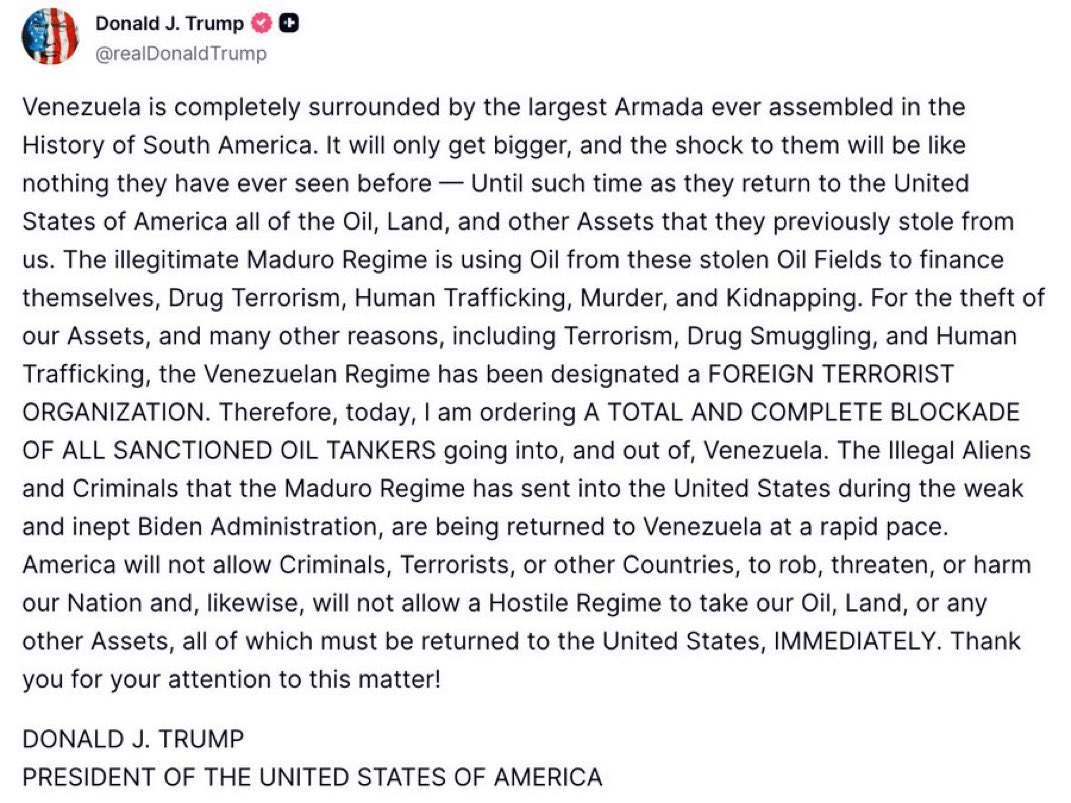
In these questions, the journalists were referencing a December 16 post on Trump’s website Truth Social, in which the US president announced “A TOTAL AND COMPLETE BLOCKADE OF ALL SANCTIONED OIL TANKERS going into, and out of, Venezuela”.
These US sanctions on Venezuela’s oil industry are unilateral coercive measures and do not have the approval of the UN Security Council, and are therefore illegal under international law.
In his post, Trump demanded “all of the Oil, Land, and other Assets that they [Venezuela] previously stole from us”.
He was referencing Venezuelan oil, Venezuelan land, and Venezuelan assets, which Trump believes are the property of the United States.
Hugo Chávez’s full nationalization of Venezuela’s oil industry
Venezuela has the world’s largest oil reserves.
US corporations have been desperate to get access to the country’s crude since 2007, when leftist former President Hugo Chávez fully nationalized Venezuela’s oil industry.
The Venezuelan government passed a policy mandating that the state oil company PDVSA must have majority ownership of all projects. Foreign firms were only allowed to have a minority stake, in joint ventures.
Major US corporations like ConocoPhillips, Chevron, and ExxonMobil refused to accept these terms, and thus left the country.
The Trump administration has portrayed this nationalization from 18 years ago as an attack on the United States.
Trump boasted of trying to take Venezuela’s oil
This is by no means the first time that Trump has targeted Venezuela’s natural resources.
During his first term as US president, in 2019, Trump launched another coup attempt in Venezuela. He appointed a little-known right-wing opposition politician, Juan Guaidó, as he supposed “interim president” of Venezuela.
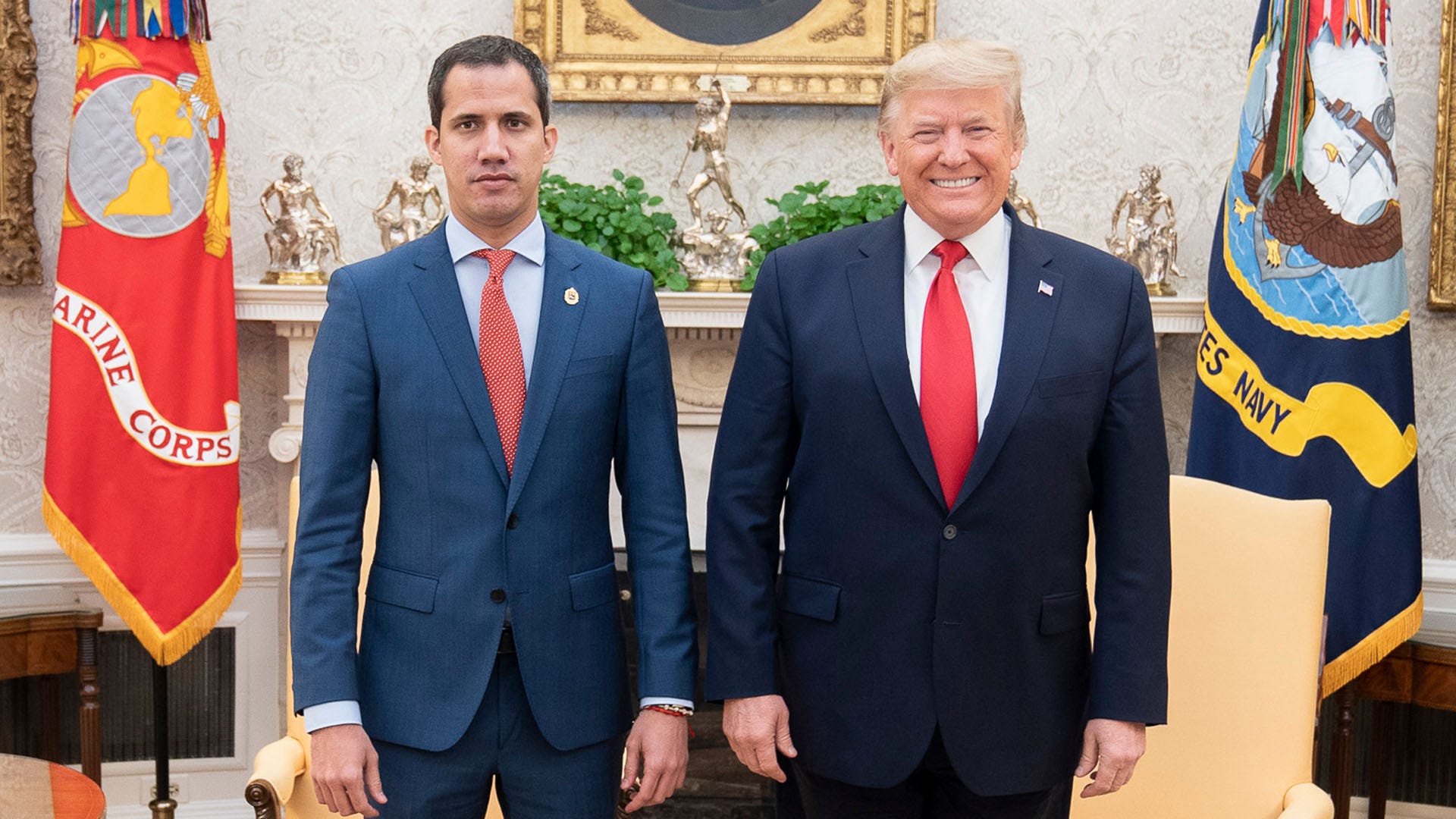
Although that coup attempt failed, Trump later admitted that the goal was to “take over” Venezuela and pillage its oil — treating the sovereign, independent country like a US colony.
In a 2023 speech at a Republican Party rally, Trump declared:
Venezuela, how about we’re buying oil from Venezuela? When I left, Venezuela was ready to collapse. We would have taken it over. We would have gotten all that oil. It would have been right next door.
Trump’s first secretary of state was CEO of ExxonMobil
In his first administration, Trump’s initial secretary of state was Rex Tillerson, who served as the chairman and CEO of ExxonMobil from 2006 to 2016.
ExxonMobil was one of the major US oil corporations that left Venezuela in 2007, following the full nationalization of the industry under Hugo Chávez.
Ever since, ExxonMobil has been desperate to get back into Venezuela.
In fact, ExxonMobil sued the Venezuelan government in the International Center for Settlement of Investment Disputes (ICSID), a corporate tribunal run by the World Bank Group, which is dominated by the US government.
Tillerson served as ExxonMobil’s CEO when the corporation sued Venezuela. Soon after, he was ushered through the revolving door to the head of the State Department, overseeing US foreign policy.
Top Trump aide Stephen Miller claims Venezuela’s oil belongs to the USA
It is not just Trump but also his top aides who insist that Venezuela’s oil belongs to the United States.
Trump’s notorious, far-right deputy chief of staff for policy, Stephen Miller, is helping to supervise the US war on Venezuela.
In a Twitter post on December 17, Miller claimed that “American sweat, ingenuity and toil created the oil industry in Venezuela”.
“Its tyrannical expropriation was the largest recorded theft of American wealth and property”, he wrote.
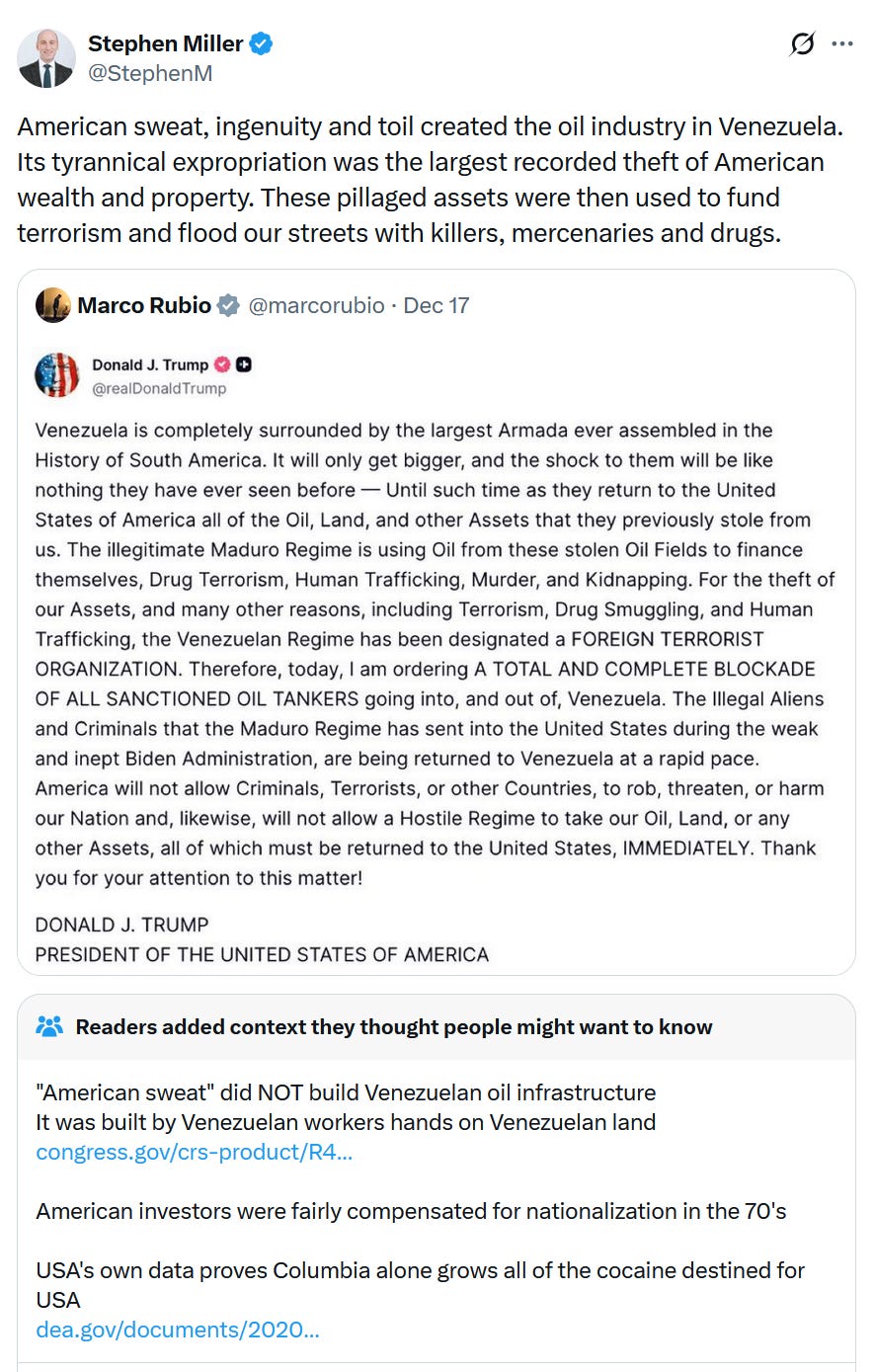
Miller’s extremely misleading claims earned a community note on Twitter, which pointed out that Venezuela’s oil infrastructure was actually built by Venezuelan workers on Venezuelan land.
The community note added that US investors had been compensated after Venezuela’s oil industry was initially nationalized in 1976.
Miller’s false accusation that Venezuela is responsible for drug production was likewise debunked by the Twitter community note, which pointed to the US government’s own reports, from the DEA, showing that it is actually longtime US ally Colombia, not Venezuela, that is responsible for cocaine that is trafficked into the US.
US naval blockade cuts of Venezuelan exports and imports
The Trump administration launched a war against Venezuela in September. As of December 19, the US military had killed more than 100 people in strikes on boats in the Caribbean Sea and eastern Pacific Ocean.
Throughout this war, the Trump administration gradually escalated its aggressive tactics, seeking to destabilize and overthrow Venezuelan President Nicolás Maduro.
In December, the US government started to seize oil tankers off the coast of Venezuela, in blatant violation of international law.
When Trump was asked what the US government would do with the Venezuelan oil in these tankers, his response was, “We keep it”. This is piracy.
Reuters reported that several supertankers that had planned to collect crude oil in Venezuela were forced to make U-turns and avoid the region, because the US military threatened to steal their cargo.
However, the Trump administration did make one exception: it allowed tankers from the US oil corporation Chevron to go through.
This US naval blockade immediately led to a significant fall in Venezuela’s oil exports.
The Trump administration also blocked Venezuela from importing goods like naphtha, which is used to refine Venezuela’s heavy crude.
The goal of the naval blockade is clear: the Trump administration wants to prevent Venezuela from exporting oil to starve the government of revenue. It also has the supplementary geopolitical effect of denying crude to Washington’s main adversary, given that around 80% of Venezuela’s oil exports are bought by China.
With his blockade, Trump wants to cut off Venezuela’s access to hard currency, cause hyper-inflation, and collapse the economy.
Washington is also trying to block Venezuela from importing crucial goods that would be needed to maintain economic stability. This not only includes the materials needed to refine Venezuela’s heavy crude, but also food.
Venezuela is dependent on importing much of its food. So, with its naval blockade, the US government aims to use hunger as a weapon, to cause mass chaos and social instability in the country, and to destabilize and overthrow the government of President Maduro.
Even the US business press, like Fortune magazine, warned that the US blockade could “devastate” the Venezuelan economy.
The US government’s imperial strategy: “make the economy scream”
In other words, Trump is bringing back the infamous US imperial strategy known as “make the economy scream”. This phrase originated with Richard Nixon and Henry Kissinger.
In 1970, US President Nixon and his top advisor Kissinger met at the White House with Director of Central Intelligence Richard Helms.
They convened to discuss the election of socialist Salvador Allende as the president of Chile (who went on to nationalize some of the world’s largest reserves of copper, angering US corporations and their representatives in Washington — just as Chávez would do with Venezuela’s oil a few decades later).
The CIA was given a clear mission to destabilize and ultimately overthrow Allende’s elected government.
“Make the economy scream”, CIA Director Helms was told.
The CIA was ordered to use the “best men we have”, in a “full-time job”. It was given a budget of $10 million, promising “more if necessary”. That was equivalent to nearly $83 million as of late 2025.
The US ultimately succeeded in sabotaging the Chilean economy, causing high rates of inflation and chaos. The CIA even worked with right-wing labor unions to carry out strikes that paralyzed the country.
Then, on September 11, 1973, the CIA backed a military coup that overthrew Chile’s elected President Allende, and put in power the fascist dictator Augusto Pinochet.
US coup attempts, illegal sanctions, and economic war on Venezuela
This is precisely the imperial strategy that the US empire has used to try to topple Venezuela’s left-wing government, over more than two decades.
Washington has sponsored many coup attempts in Venezuela, including a briefly successful putsch in 2002, which was overturned by the Venezuelan people.
After these coup attempts failed, the US government resorted to economic war.
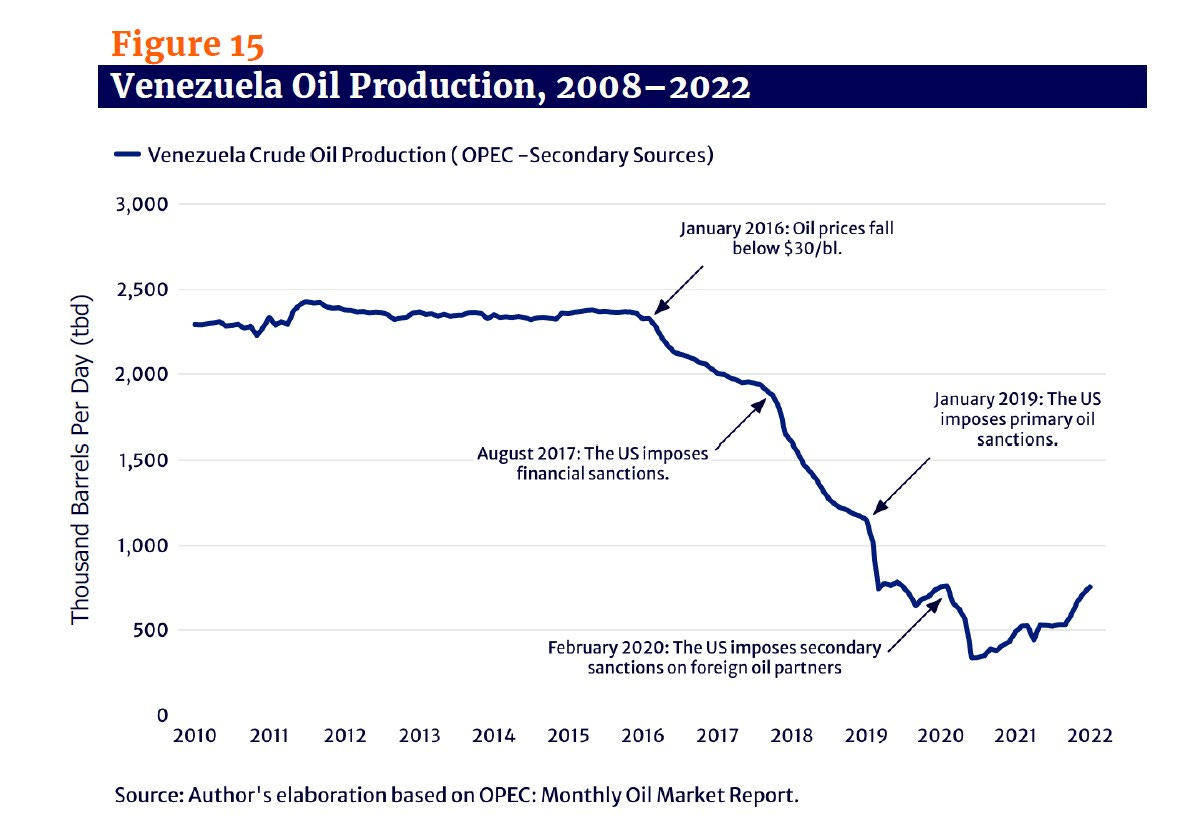
The Barack Obama administration started imposing sanctions on Venezuela in 2015. The White House even passed an executive order “declaring a national emergency with respect to the unusual and extraordinary threat to the national security and foreign policy of the United States posed by the situation in Venezuela”.
When Trump came into office in his first term in 2017, he levied heavy sanctions against the Venezuelan government and the state-owned oil company, PDVSA.
In 2019, Trump escalated this hybrid war into a full economic embargo on Venezuela.
UN experts made it clear that these unilateral US sanctions on Venezuela were illegal.
The UN special rapporteur on the negative impact of unilateral coercive measures on the enjoyment of human rights, Alena Douhan, wrote that the US sanctions “constitute a violation of international law”.
“The announced purpose of the ‘maximum pressure’ campaign – to change the Government of Venezuela – violates the principle of sovereign equality of states and constitutes an intervention in the domestic affairs of Venezuela”, Douhan stressed.
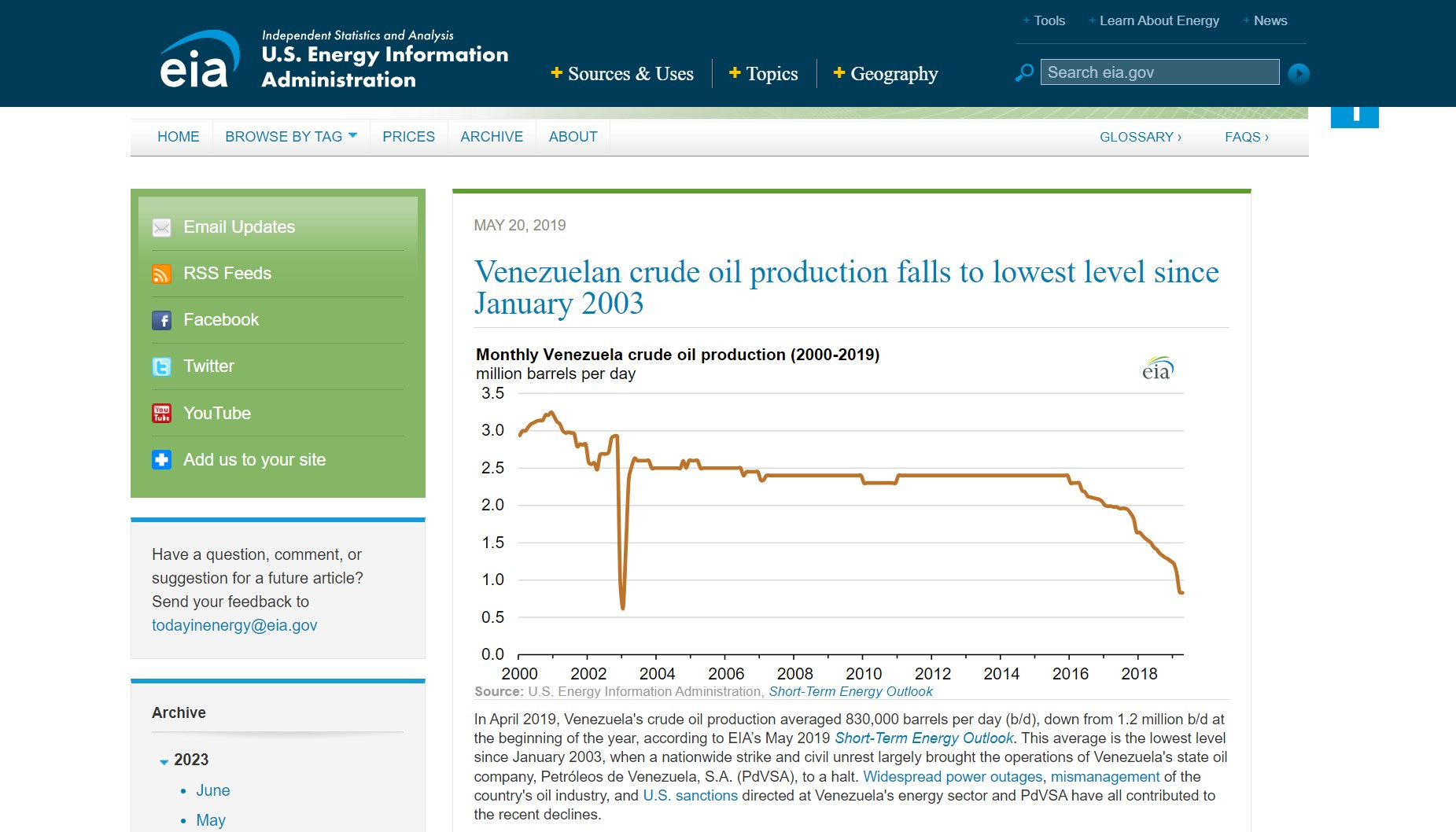
As the US government steadily increased the number of illegal sanctions, Venezuela’s oil production crashed. The South American nation not only found it difficult to export its crude, but it was unable to import the technologies, parts, and products needed to repair and modernize its oil infrastructure.
The US Energy Information Administration (EIA) boasted in 2019, during the previous Trump administration’s coup attempt, that Venezuelan crude oil production had collapsed.
The EIA admitted that one of the main reasons for this was the “U.S. sanctions directed at Venezuela’s energy sector and PdVSA”.
The coup attempt that Trump initiated in 2019 failed. So in his second term, under Secretary of State Marco Rubio, Trump launched another putsch.
This time, they used the US military to try to directly force President Maduro from power.
“Make the economy scream”, CIA Director Helms was told.". An Imperialist euphemism for making the masses of workers and poor people of Latin America scream.
Trump's NSS is pretty clear on enforcing a neo Monroe Doctrine in this hemisphere as it has become obvious it cannot topple its competitors in China/Russia. I support the victims of Imperialism in Venezuela as I do in Russia and China. But, this situation is much more dangerous as Imperialism may actually still have the ability to achieve its goals against an impoverished and weak Venezuela.
The sad thing about US foreign policy is that the people who run things (without ther eal consent of the American public) is that they never seem to learn from their failures. Under what sort of logic does Trump assume American sovereignty over another countries property? The illogic of it is self-evident. It should be noted that Rex Tillerson went on to describe Trump as "A Fucking Moron."