


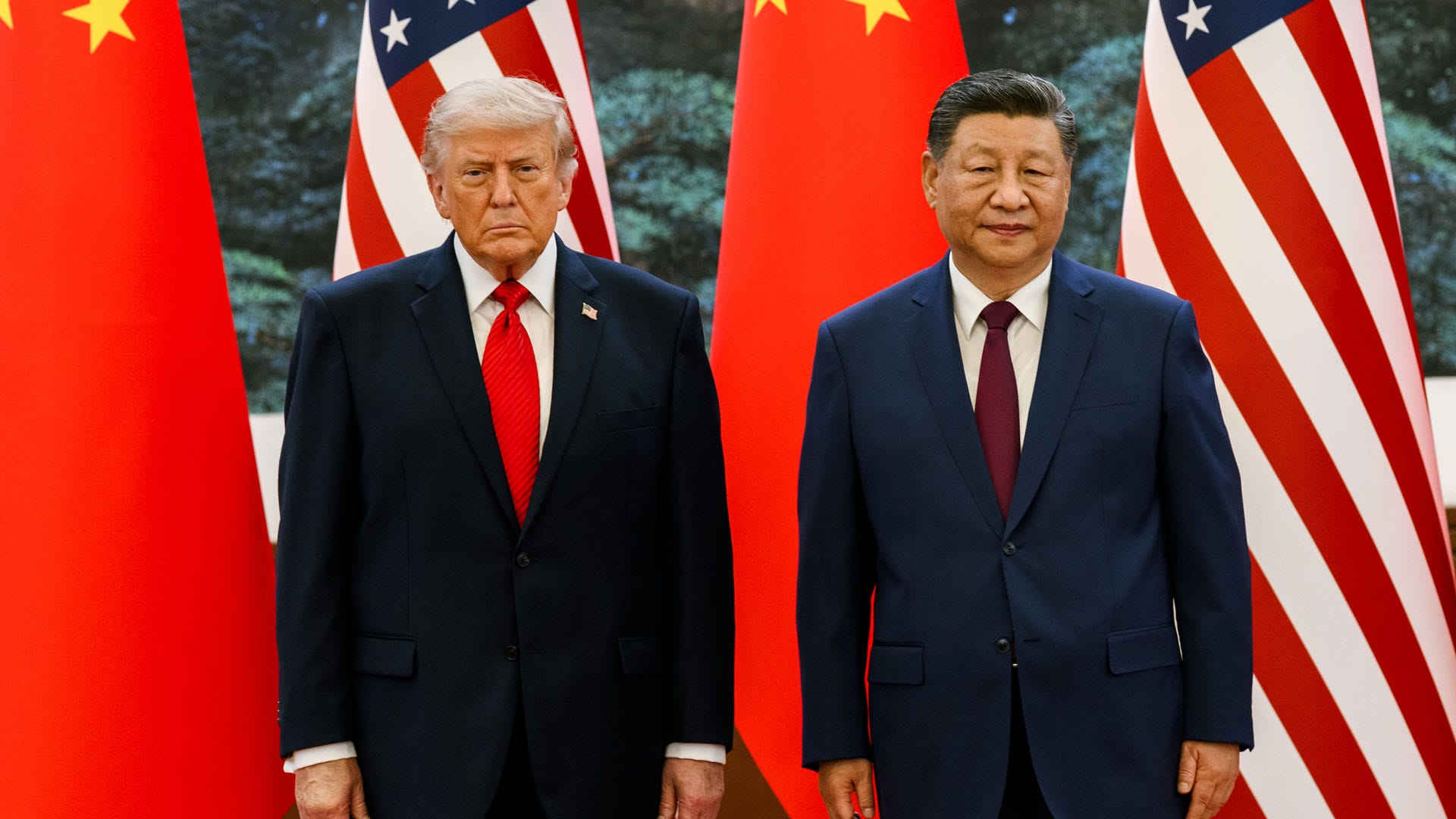
Donald Trump’s visit to Beijing this May marked the first time a sitting US president traveled to China since 2017.
To understand this trip, it is important to emphasize that it was the United States that requested the meeting. Beijing did not initiate it.
This begs the question: Why was Trump so desperate to sit down with China’s President Xi Jinping?
The short answer is the US economy is in dire straits.
The aggressive trade war that the US launched against China during Trump’s first term, which he then heavily escalated in 2025, has backfired spectacularly.
Inflation is rising fast in the US, and Trump’s tariffs have only poured fuel on the inflationary fire, while also accelerating deindustrialization and supply-chain dysfunction.
Washington is operating from a position of distinct vulnerability. Even major US think tanks like the Council on Foreign Relations now openly acknowledge that Beijing has “the upper hand”, and Washington “has lost its leverage over China”.
Trump invited the CEOs of a dozen US corporations to travel to China with him
Trump has never been one for subtlety. He constantly “says the quiet part loud”.
On his website Truth Social, Trump boasted about the corporate entourage accompanying him to China. The US delegation consisted of many of the most powerful billionaire oligarchs in the country:
Elon Musk of Tesla and SpaceX, the world’s richest billionaire oligarch, who spent $288 million to get Trump and his Republican allies elected;
Jensen Huang of Nvidia, which is now the world’s most valuable corporation, with a $5.5 trillion market capitalization, driven by the AI bubble;
Tim Cook of Apple, whom Trump calls “Tim Apple”;
Larry Fink of BlackRock, the world’s largest asset manager;
Stephen Schwarzman of Blackstone, the biggest alternative asset manager, and Schwarzman was a major funder of Trump’s 2024 presidential campaign;
Boeing CEO Kelly Ortberg;
Cargill CEO Brian Sikes;
Citigroup CEO Jane Fraser;
GE Aerospace CEO Larry Culp;
Goldman Sachs CEO David Solomon;
Micron CEO Sanjay Mehrotra; and
Qualcomm CEO Cristiano Amon.
In fact, when Trump flew to China, he was physically joined on Air Force One by the billionaires Musk and Huang.
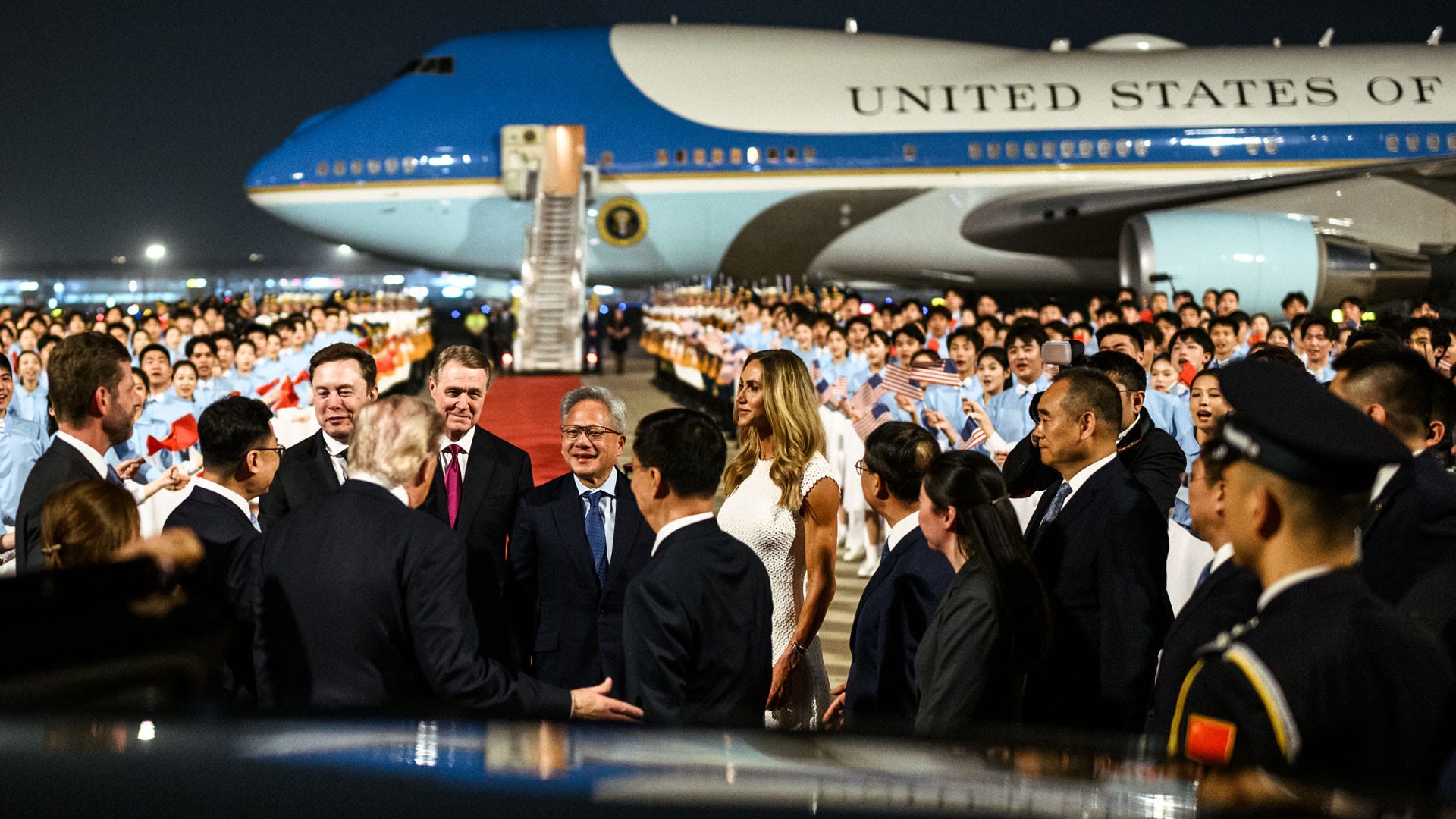
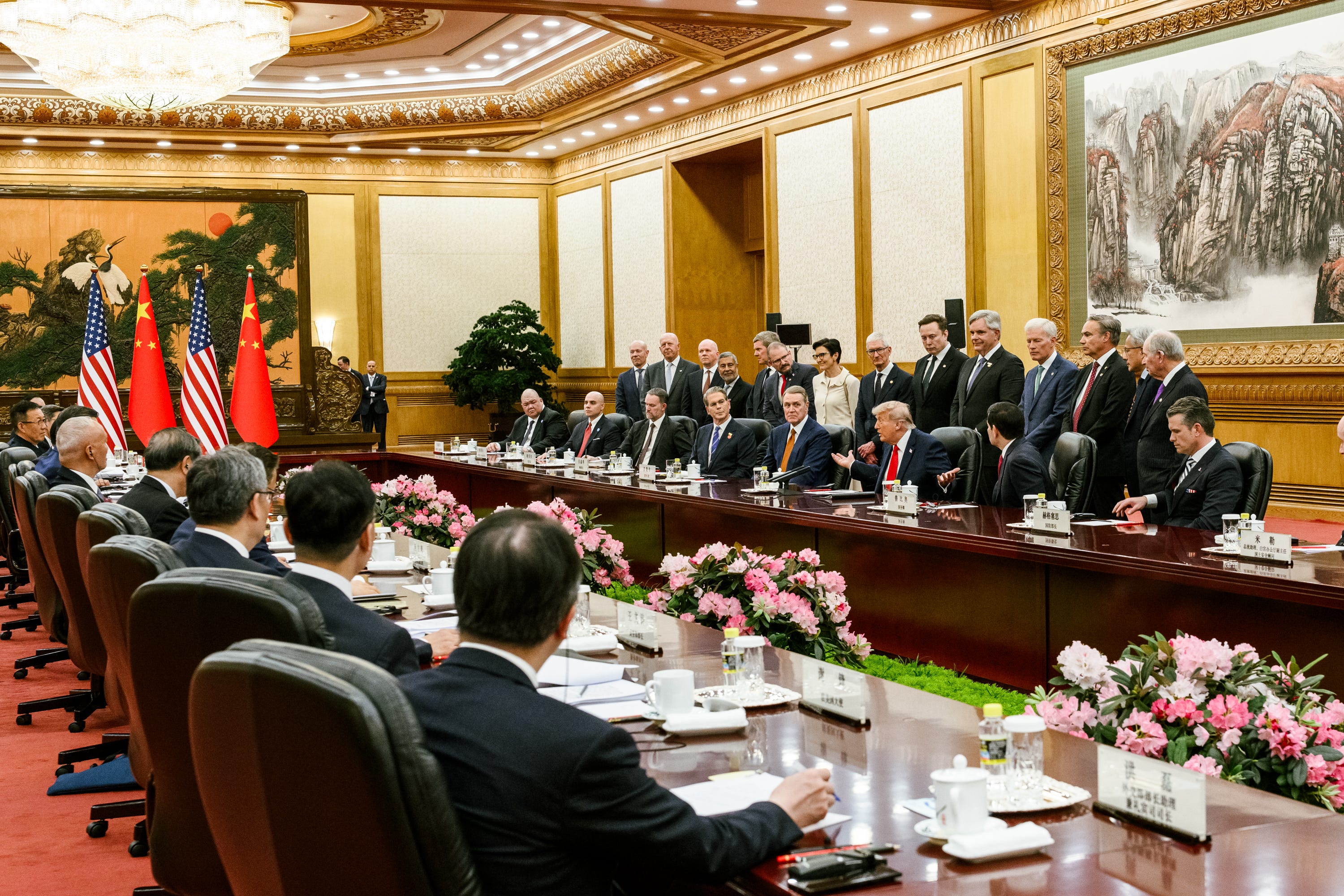
When the US president met with the Chinese leadership, he was flanked by these corporate oligarchs.
The symbolism was unmistakable: these CEOs were effectively being treated as shadow government officials.
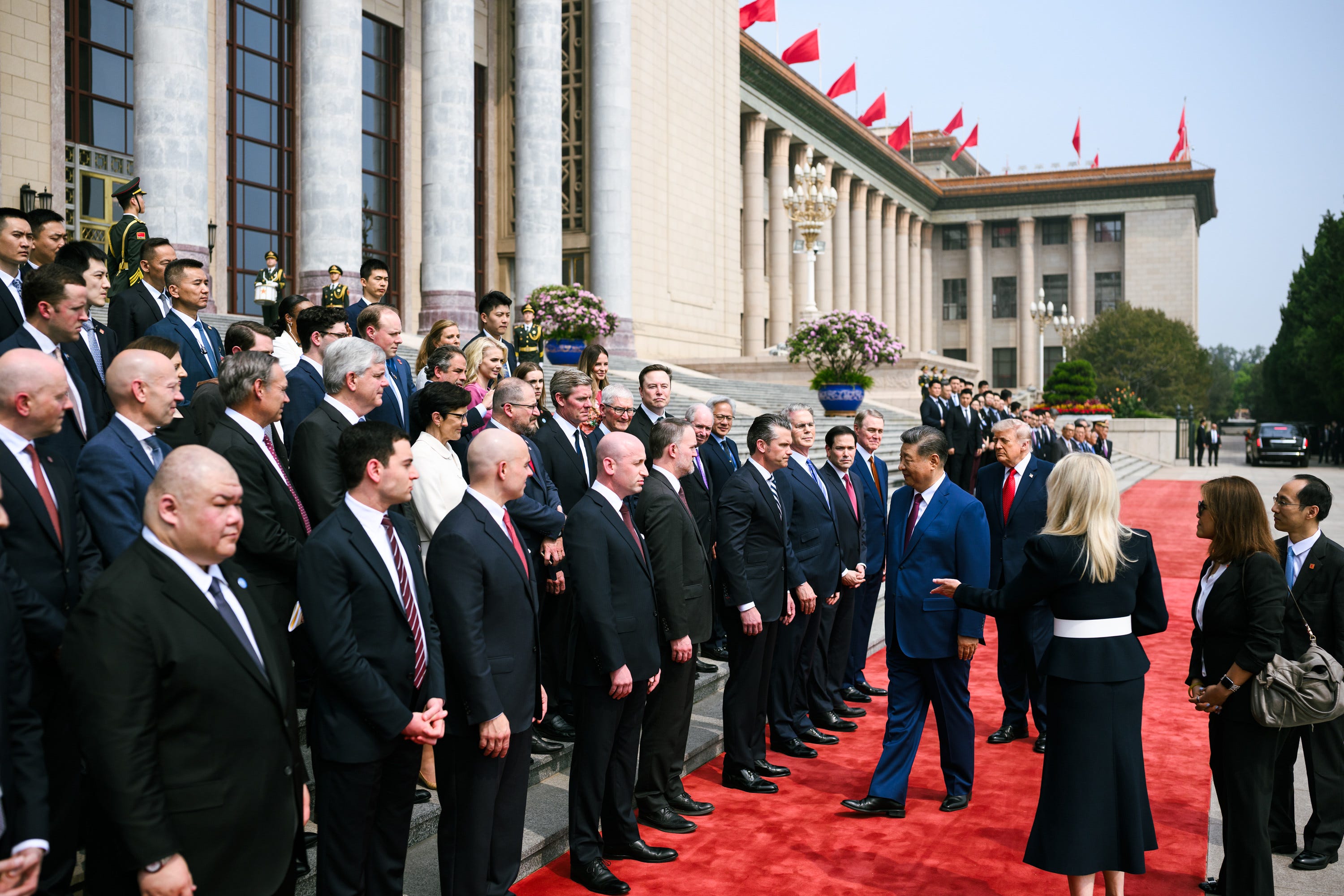
It was the clearest demonstration that US government policy is made by and for large corporations, and the rich elites who run and invest in them.
Only further confirming this is the fact that the US ambassador in China, David Perdue, was previously the president of Reebok and CEO of Dollar General.
US trade war backfired: Nvidia’s market share in China went from 95% to 0%
Why were these US corporate executives so eager to travel to China with Trump? The answer is simple: They are desperate to secure access to the world’s largest market.
China has a population of 1.4 billion people, including the largest middle class on Earth. Brookings Institution researchers estimated that there will be 1.2 billion Chinese in the middle class in 2027, which is a quarter of the entire world’s middle class.
“China already makes up the largest middle-class consumption market segment in the world and is a priority market for major multinational firms”, the researchers wrote.
US corporations have always been desperate to penetrate China’s enormous market. After Deng Xiaoping initiated the Reform and Opening Up in 1978, he allowed some to do so under the condition that they share their technology and establish joint ventures with Chinese firms. The slogan was “market (access) for technology (transfer)”: 市场换技术 (shìchǎng huàn jìshù).
When Trump launched the US trade war against China in 2018, he put the two countries on the gradual path toward economic “decoupling”. This is a slow process, but trade and investment between the US and China have fallen significantly in the past decade.
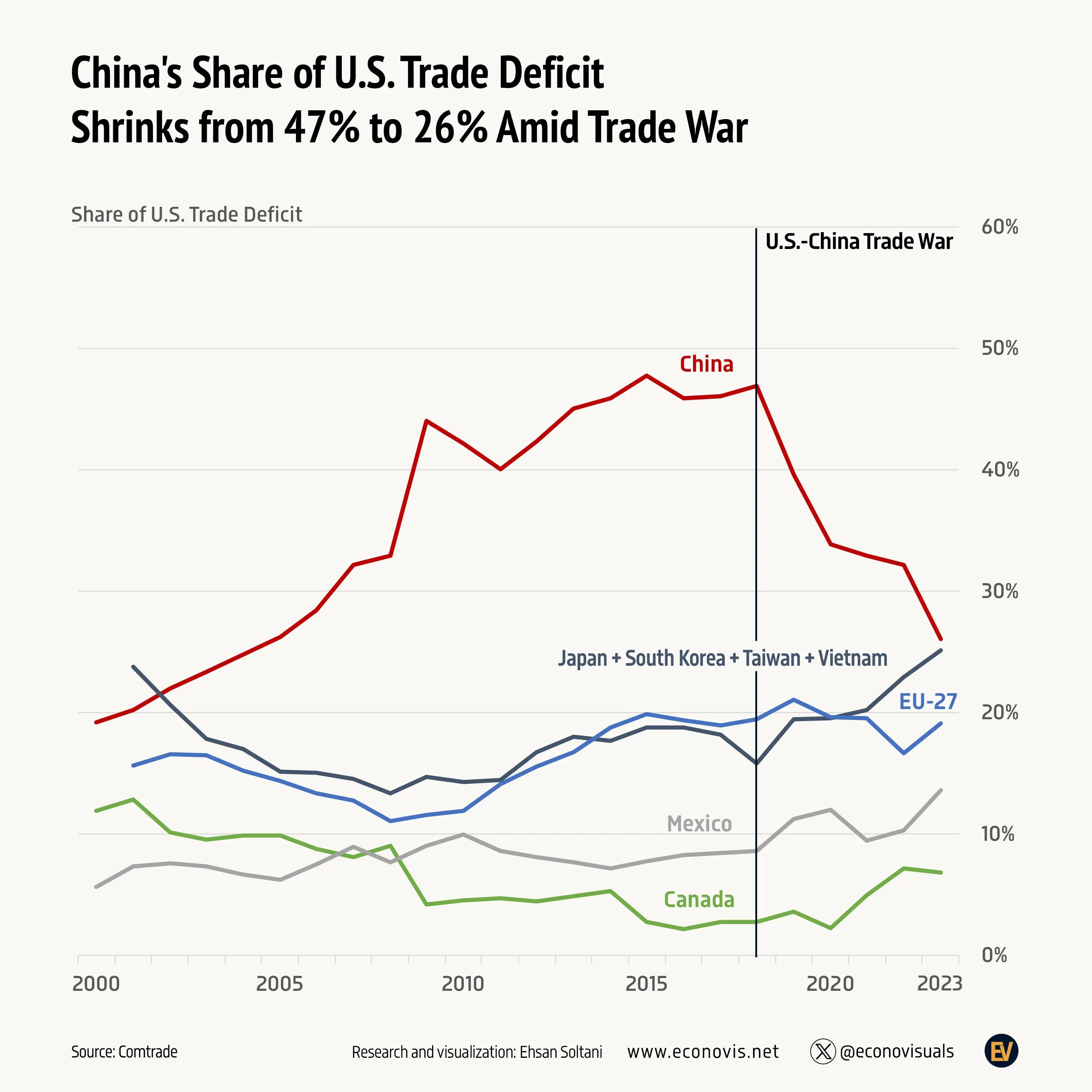
Some major US corporations have been very negatively impacted by this trade war.
In particular, the prominent presence of Nvidia CEO Jensen Huang in Trump’s trip to China highlighted the stark failure of Washington’s tech containment strategy.
In an effort to sabotage China’s AI development, both the Biden and Trump administrations restricted the export of advanced chips.
This campaign of tech warfare — known as the “chip war” — blew back hard on Nvidia. Huang lamented that the US corporation previously controlled 95% of the Chinese market for advanced AI chips, but its market share has fallen to zero.
Instead of allowing the US to monopolize AI and other advanced technologies, Beijing responded by pouring billions of dollars into industrial policy measures, to develop its own domestic semiconductor industry.
China has made rapid progress. It is now dominating the global market for legacy chips, and will likely catch up to US Big Tech companies very soon.
Some US corporate executives have clearly asked Trump to reconsider his strategy. The scorched-earth campaign of economic war and tech war against China has backfired, and they hoped for some kind of grand bargain.
Trump’s trip was a failure: China wasn’t interested
However, Beijing was apparently not nearly as interested as Washington was.
Many Western media outlets acknowledged that very little came out of the trip. Some even called it a failure. Trump returned home mostly empty-handed.
Trump boasted that China will order 200 planes from Boeing, but the US corporation’s stock price actually fell 4% in response to this news, because analysts had expected that it would purchase 500.
The US government did give Nvidia the green light to sell its second-most advanced AI chip, the H200, to 10 Chinese tech companies, but Reuters pointed out that “not a single delivery has been made so far”.
Reuters concluded, “U.S. President Donald Trump left China on [15 May] with no major breakthroughs on trade or tangible help from Beijing to end the Iran war”.
It was easy to predict this outcome. The US government has spent nearly a decade now waging a trade and tech war, aiming to prevent China from developing, seeking to isolate the country.
Why Trump thought he could suddenly play nice, and get China to make concessions to benefit the US at its expense, is a mystery.
Moreover, the US started a war of aggression against Iran, which has disrupted the global economy and caused the largest oil crisis in history, but Trump now expects China to bail him out. It is clearly absurd.
In other words, after years of punching China in the face, Trump hopes Beijing will help to save the US economy. It is obvious why China was not interested.
China holds the cards, not the US
When Trump unilaterally escalated the trade war against China in April 2025, threatening tariffs as high as 145%, Beijing surprised Washington by hitting back, putting proportional levies on US exports.
Trump fumed, “We have much bigger and better cards than they do”. The US president claimed that he could “destroy China” with his “incredible cards”.
Treasury Secretary Scott Bessent was enraged. He went on CNBC and declared, “I think it was a big mistake, this Chinese escalation, because they’re playing with a pair of twos”.
“What do we lose by the Chinese raising tariffs on us?” asked Bessent, a former hedge-fund manager from Wall Street. “We export one-fifth to them of what they export to us, so that is a losing hand for them”.
In reality, the opposite was true: China holds significantly more valuable cards.
The clearest example of this was how Beijing responded to Washington’s unilateral tariffs and tech export restrictions by cutting off US access to rare-earth elements.
This caused a political earthquake in Washington, because US corporations cannot manufacture their products without Chinese rare earths. The US military-industrial complex cannot make its weapons systems without them either.
China dominates the global supply chain for many critical minerals.
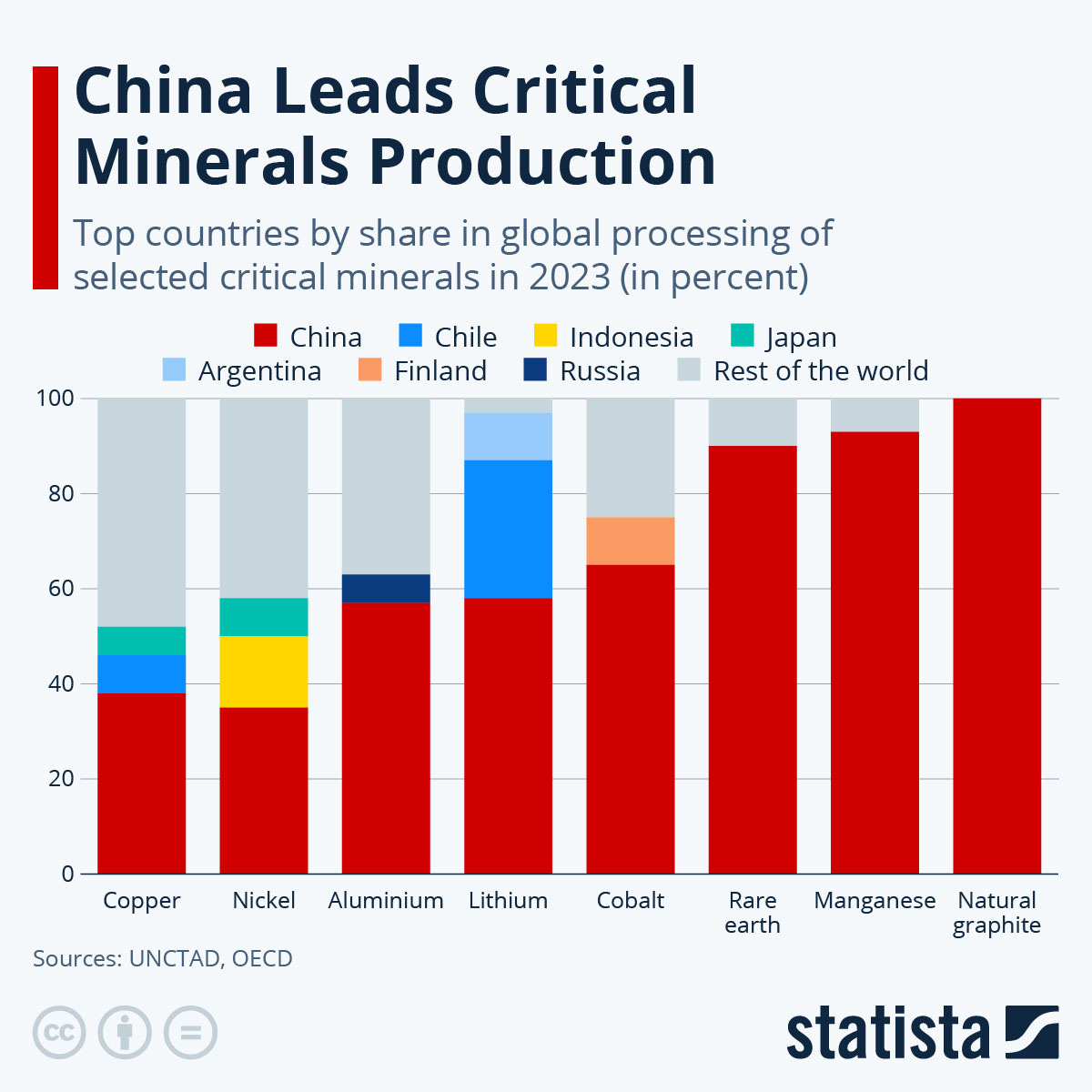
Recognizing this vulnerability, the US government has sought to develop a new supply chain. Under Marco Rubio, the State Department launched a “Pax Silica” initiative, and invited dozens of countries this February to participate in its Critical Minerals Ministerial in Washington.
However, building these parallel networks will take years, meaning the US has no option but to play nice with China if it wants critical minerals.
In terms of Chinese leverage, the presence of Elon Musk and Apple CEO Tim Cook on Trump’s trip was especially telling.
For nearly a decade, Washington has pressured US companies to “de-risk” by moving production lines out of China, “friendshoring” factories to countries like India.
However, shifting these supply chains has proven to be nearly impossible, given the complexity of China’s domestic manufacturing ecosystem.
Apple has tried to make its iPhones in India, but has faced many problems.
Tesla serves as the ultimate case study. More than half of the company’s electric vehicles (EVs) are manufactured at its “gigafactory” in Shanghai.
This is despite the fact that, in 2024, Tesla CEO Elon Musk asked for domestic trade barriers, warning that his Chinese competitors would “demolish” US EV manufacturers. Soon after, the US government (then under Joe Biden) put 100% tariffs on Chinese EVs.
All of this demonstrates the extreme hypocrisy of US policy toward China. Washington wants Beijing to sacrifice its own interests to serve those of US corporations. Some comprador elites in other countries may be willing to do so, to enrich themselves at their nation’s expense; but not China’s leadership, which is dedicated to developing its country.
The United States is learning the hard way that it can no longer push around China.
Trump & his US billionaire beggars all FAIL in China. What a pack of idiots! What did they expect?!
Trump is just the symptom of the failures of American foreign policies across the globe. From Vietnam, Iraq contra, Iraq, Ukraine, Nord Stream pipelines sabotage and now the war in Iran. China like all members of the global south, they have been watching closely.
America has become an empire that demonstrates a lack of understanding of the wider world and how that world is swiftly charging. These changes are also visible among Europeans.. A long time group of allies who are now rethinking their commitment to the American project.
Like it or not, the empire is in decline. Better to accept those facts and make the appropriate adjustments in order to mitigate the fall.